The people who come to our Hubs have many different needs. How do we recognise those needs, and provide them with support ourselves, and how do we make referrals to other organisations ?
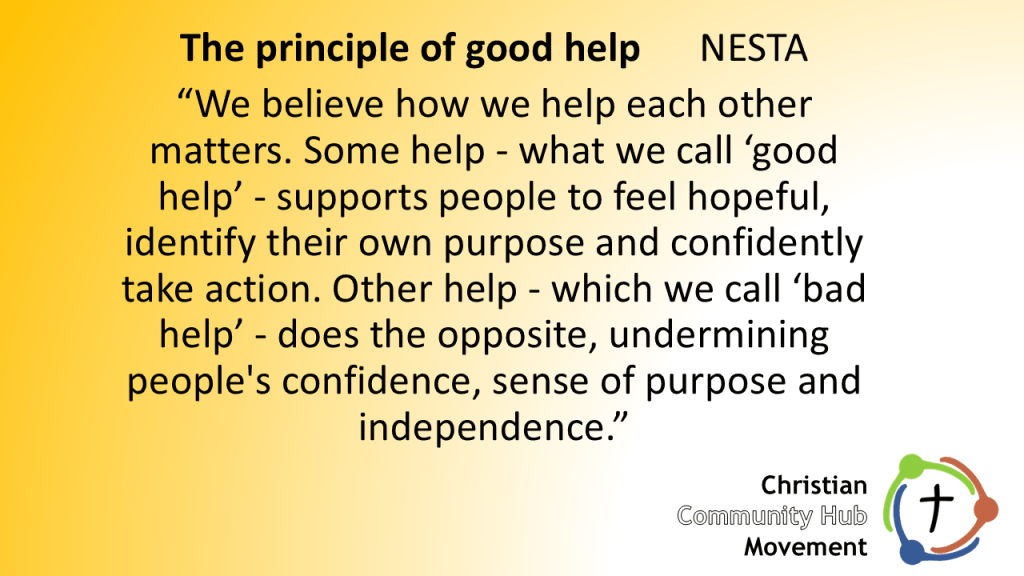
The principle of good help was developed by NESTA, a UK innovation agency for social good. http://www.nesta.org.uk
Genesis Trust in Bath, a charity that emerged from Bath’s churches as a volunteer-led organisation supporting people in need, and is now fully professional, providing Good Help for hundreds of people every year along their personal journey from crisis and dependence, through new beginnings, to independence and better futures. http://www.genesistrust.org.uk
Guests are personally supported with many 1-to-1 conversations, and the opportunity to take part in many different activities, backed by shared goal setting and measured achievements. The outcomes are remarkable, and many lives are blessed. This is a professional organisation, with paid staff still supported by volunteers.
How can this level of support and guidance be replicated across a number of hubs that are operating in the same town or city ? Some of these will be operating for one day a week, or less. How can the church, and the hubs we run, be an integral part of “how this place works” ? We can satisfy some of these needs ourselves, but not all of them. How can we link together, and link with hubs run by charities and by the local authority ?
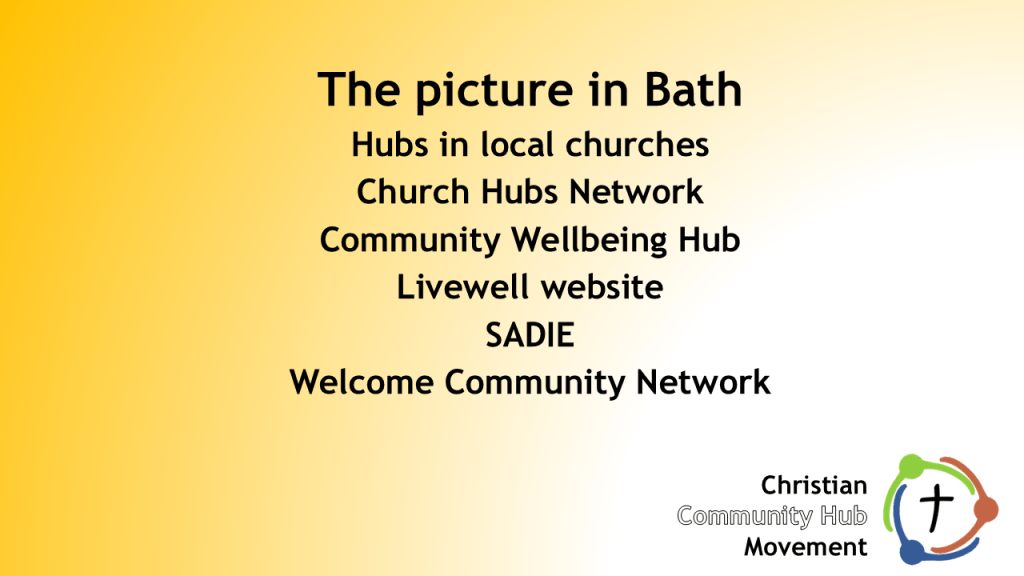
We are trying to answer these questions in Bath, so as to provide a better joined-up service by all our operators. A lot of our hubs and the relevant Council departments held meetings, dinners and other conversations and together recognised the following needs.
· That we should have a Hub within 15 minutes walk of everyone living in the city
· That these hubs should be places of welcome and of safety, where people can build trusting relationships
· That this sense of belonging should enable conversations about any real needs that may need more specialised support
· That there should be ways of referring people to places where they can receive further support and encouragement
· That there should be ways of assisting them to get to helpful appointments in unfamiliar locations
So we realised that we need to have a structure for our area, that enables professionals and volunteers to interact and work together, with mutual trust and with permission to share information.
So far, this journey has gone through 6 stages. We are not there yet, and it is still work in progress.
1 Hubs in local churches
We identified all the Hubs in our local churches. The core activities of the Hubs cater for different types of guest (in terms of age, ability and personal challenges). We found that we already have a church-run Hub within 15 minutes walk of most people living in the city. But the Hubs were mainly operating independently.
2 Church Hubs Network
We started a local network that links all our church-run Hubs together, with dinners and workshops. We recognised that every Hub is different, but that we have a shared purpose, and can encourage and support each other. This has raised the profile of Hubs, and their importance in our communities.
3 Community Wellbeing Hub
The local Council set this up at the beginning of Covid, working with our 3rd sector group 3SG, and with other organisations. It is a hotline where people in need (or their supporters) can phone and talk to a trained helper who can do
initial triaging on the phone, and then direct them to a relevant organisation in the city. There is a shared online information form, which is used by all the organisations. http://www.communitywellbeinghub.co.uk
4 Livewell website
The local council set up a website that provides information on all the providers in the area, presented under different categories, and used for online searching. http://www.livewell.bathnes.gov.uk The Hope Guide is also available, with a similar purpose. https://ks2bath.org/hopeguide/
5 Artificial Intelligence brings another dimension
We are about to launch a new system that will easily direct people to the best places. It will be interactive, and easy to use. It is designed for volunteers to use while talking with a guest, helping volunteers to undertake this task, and making services more accessible.
6 Welcome Community Network
This network brings together churches, charities, Council, schools, surgeries and communities, to answer the two questions… ”How can we connect better ?” and “How can our guests’ journeys be better ?”
Between us, we have many places where people can receive help, but we are not all well connected. So improving the connections will help both our organisations and our guests/clients/patients. This links with social prescribing from doctors’ surgeries.
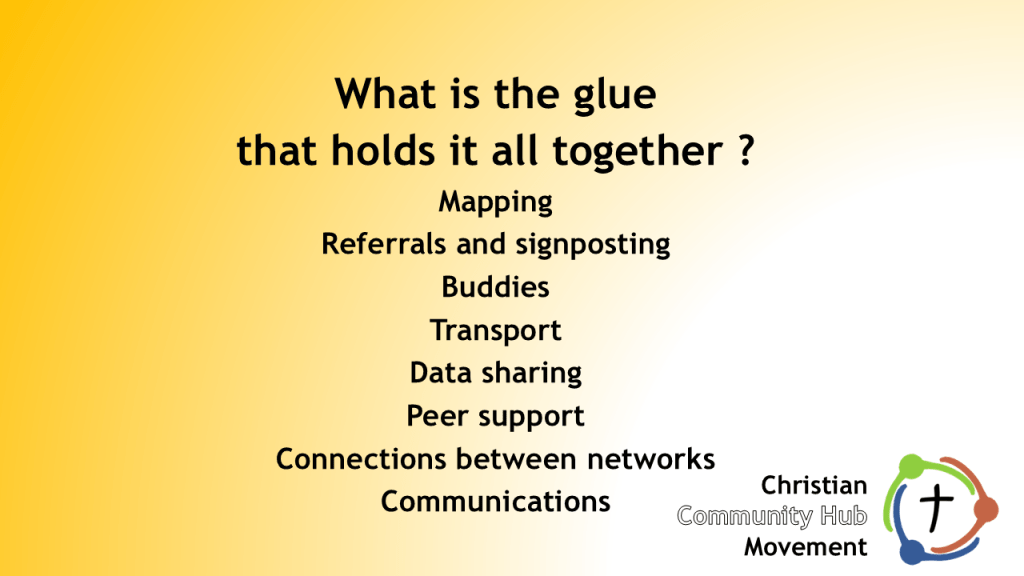
Also… Referrals and signposting · Using the artificial intelligence system and improving communications.
Community Connectors Individuals in each area/church/hub who can be there for people who need support in different ways.
Transport · Transport to hospital appointments and to other provider
Getting permissions for sharing standard data between organisations
Linking hubs together for mutual advice and support
If you would like to know more about our journey so far, or about any of these areas, please get in touch via the Christian Community Hub Movement office
Peter Heywood, Bath
 Christian Community Hub Movement